Showing posts with label web hosting. Show all posts

Friday, 18 September 2015

Types of Cloud Computing


Cloud computing enables companies to create and connect to large pools of organizational databases, thus enabling flexible and convenient access to the organization’s informational resources. This is especially suitable for today’s internationalized business models. The bottom line is thus that all companies today are somehow looking into cloud computing as a sustainable option for their applications, data and file storing needs.

Types of Cloud Computing

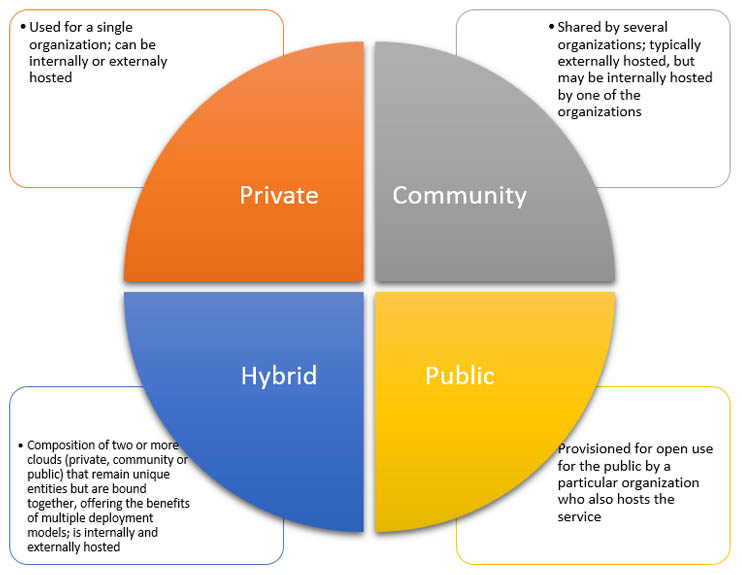
There are four types of cloud computing that these companies can choose from, including public, private, hybrid and community cloud. Each of these types of cloud computing has its unique set of characteristics that determine whether they are relevant depending on the needs of the company in question. This means that before choosing a type of cloud computing the company needs to evaluate their needs and decide on what to expect from the cloud computing.


Types of Cloud Computing

Private Clouds

The private clouds are on the other hand dedicated or created and operated specifically for a given organization. They could be hosted and managed internally within the organization or externally through a third party depending on the needs of the organization in question. The On Premise Private cloud is where the cloud is hosted within the organization and their IT department takes responsibility for all the incurred costs and required activities of running an maintaining the cloud. The externally hosted private cloud on the other hand implies outsourcing the cloud computing service to a third party without having to share the infrastructure with another organization. Either way, the company here is reassured of security and privacy and this type of cloud computing would work best for an organization that values the privacy and security of their databases. It is however rather expensive. Such organizations can meet the cost by also providing cloud computing services to other organizations at a fee.

Hybrid Clouds

A hybrid cloud incorporates all the above mentioned cloud computing types in one bundle to provide the convenience of reaping the advantages of each type of cloud computing. In this kind of cloud, you use two or more clouds, spreading out your cloud computing needs against the numerous types for more effective services. You can also host other organizations given the vast opportunities that are created especially when you merge a public and a private cloud to create a private cloud that has been augmented with the unlimited resources of a public cloud. The challenge is that you will need both on premise infrastructure and off site server based infrastructure. Hybrids are thus expensive to set up but cheap to manage as you can offer cloud computing services to many other organizations at a fee.

Public Clouds

The public clouds have a rather low level of security and available variances because the cloud here is operated by one service provider who offers access to the cloud through the internet. The public cloud is however convenient in cases where there are a lot of users which would imply a serious standard workload. Also, the public cloud is very cheap seeing as he cost is spread out across all the users. Google for example is able to provide cloud computing services at almost no cost at all. If your company needs an incremental capacity, has a huge workload for applications and is not keen on high levels of security then the public cloud will serve you well.

Community Clouds

This involves a private cloud that is shared by a number of organizations and either managed by all these organizations or by a third party. Ordinarily, these organizations must have a shared set of cloud computing requirements in order for customized cloud characteristics to work effectively for all of them. This kind of cloud computing is best for large organizations that have numerous independent departments, like governments and international organizations like the UN.

Conclusion

Companies have to pick out a cloud computing type based on their needs and expectations with respect to cloud computing. At this point, all companies have to be considering the concept of cloud computing seeing as it is not only convenient but also highly economical in terms of enabling them to work seamlessly across the globe. Whether you settle for a public, private, community or hybrid server, cloud computing is the way to go in business but it will only work if it is relevant to your organizational needs.

Thursday, 17 September 2015

Cloud Computing Benefits for Small Business

Cloud Computing
A small business owner who has no idea of what cloud computing is may have a hard time accepting cloud computing. But after going through the detailed benefit I have laid down below am sure the reader will be left convinced that cloud computing is the best for the small businesses. In the past computer user had only of accessing and using their information on the computer that is running it on a physical computer through software downloaded to it. Nevertheless, with cloud computing the computing service are based on the internet. The benefits include improves cash flow and increased efficiency.
Flexibility makes cloud computing also a favorite for business owner since it is able to meet they demand. Using cloud computing means that the business no longer needs a disaster recovery plan, this because cloud computing is able to provide solutions to issues faster taking a quarter of the time spent by other business that are non cloud.
The automatic software updates saves the business time and resources that would have been spent doing it. The security update is done by the service providers as well as maintaining the server.
No capital expenditure needed with cloud computing since it is typically pay as you use thus only a minimum start up cost is needed. Document control whereby the employees can chat as they work on a single document is another advantage of cloud computing. This process makes collaboration stronger thus improving on efficiency.
Another advantage is data security no matter what happens to the machine the data can still be used as it saved on the server. Other benefits include the fact that it increases competitive advantages for the business and it is environmental friendly in that there a decrease in carbon footprint.

Tuesday, 18 August 2015

Traditional Hosting Vs Cloud Hosting


It is always interesting to participate on the debate on cloud hosting and traditional hosting. While many professionals will swear by the cloud others remain loyal to traditional hosting. Here is a run down on why you should opt for one or the other.

Big or small

The most important factor influencing your choice of Business hosting is whether you have a small or large online footprint. There are many successful but small websites which can very well run on shared hosting. Individual blogs running on WordPress don’t need heavy resources. However, some websites may be quite small but have lots of videos which have to be streamed requiring large bandwidth. Such sites need shoring up of resources which can be fulfilled only by a cloud setup.
The big players with thousands of web pages and visitors from across the globe need a heftier hardware to work seamlessly. These giants of the internet would be well off in a set up like TDWS cloud servers. They can elastically grow or shrink their server instances quickly and save money.

Maintenance and Capital cost

Maintenance cost is almost nil in case of a cloud. You need not employ costly technical staff to deploy servers. In addition, a cloud hosting service is a pay per use model and you need not spend upfront for purchasing hardware. Expenses can be budgeted and server capacity added or reduced as per demand or traffic. This is a major advantage of cloud hosting. The economies of scale mean that larger the requirement more the benefit of cloud hosting. It is a sad but known fact that most new ventures fold up and very few make it beyond the first year of operation. Buying server hardware for these new ventures is therefore not recommended. A cloud hosting environment can mitigate losses in these circumstances.

Global or local market

Many traditional hosting providers cater to a local audience. This means their servers are located in a particular geographical area. If your customers belong to a different geographical location, far away from the server, website download speed would certainly be compromised. In case of cloud hosting, the footprint of the provider is usually global which results in higher download speeds all over the world. Some cloud hosting providers have a linkup with CDN services which improve website performance.

Scaling

Scaling means adding and deleting computational power of servers elastically, with demand. Seasonal businesses which experience surge in demand during certain times in a year can easily increase their servers during peak season and reduce during rest of the year. TDWS cloud servers work well with instances where for example, a website dealing with college admissions will be busy in the months of July-September. Some retail online businesses thrive during the holiday season. Such online enterprises would do well to embrace the cloud. Here, it is easy to scale infrastructure. In case of traditional hosting, it takes a month to add or delete servers. Moreover such traditional hosting services cannot respond to sudden surges in demand.

Ease of operation

Traditional hosting is complex to setup and operate. You have to install various software, beginning with the operating system. This operation has to be repeated whenever you are adding a server. In a cloud hosting environment you don’t have to carry out such activities. The cloud server instances already have preloaded operating system. Additionally, server instances can be added effortlessly. The additional benefit of cloud hosting is that you can avoid employing costly manpower to manage your online resources. Cloud hosting service providers can be approached to provide technical assistance whenever you face any problems in handling resources.
Shared enterprise hosting is preferred by smaller websites. The control panel provided by shared hosting provider is standard and usually caters to all the requirements for running a website. If your website does not require heavy resources, shared hosting can be a good option. You should remember that shared hosting means your website resides in a server which has few hundred more websites. Sudden traffic surges or spikes in other sites can cause your website to slow down.

Migration headaches

One of the major problems faced by those wanting move from traditional hosting to cloud is migration. You have obviously spent exorbitant amount of resources setting up your website and don’t want to encounter any problem in its working. This poses a serious problem in migration. One of the solutions is to use a test server and then migrate to live environment. Migration expertise is available with most cloud hosting providers and may be utilized to avoid trouble during migration.

Load balancing

Load balancing in case of cloud hosting is more efficient because it is managed over a large cluster of servers. In such instances, failure is minimized because of easy restoration from a mirror server. In many cloud hosting services, websites can be replicated or mirrored in a different geographical location. Such an arrangement results in almost nil failure due to server outage.

Security

The issue of security has been widely debated in case of cloud hosting. Some experts claim that cloud is riddled with security issues while some other feel that cloud is the most secure environment. In case of any security breach you can face downtime, which in turn can cause incalculable loss in business. Malicious viruses and dangerous hacking incidences have made users cautious. This aspect can be managed in case of traditional hosting because you are in control of the hosting environment. In cloud environment you are at the mercy of the provider. A reliable and trustworthy cloud hosting provider is therefore essential to avoid security issues.

Conclusion

Small businesses can very well remain hosted on traditional shared hosting which are cost effective and reliable. These websites do not need resources and power which a cloud hosting can provide. Entrepreneurs who cannot estimate the load on servers must choose a cloud provider where the load fluctuation can be smoothly handled by scaling. Since there is no capital expenditure, cloud hosting is economical. Both traditional and cloud hosting have a place in the scheme of things.

Originally posted here

Sunday, 16 August 2015

Choosing a Hosting Povider?


People are always saying to me how they will never understand websites and all the technical coding that is involved. I always wonder if they live in some kind of bubble or are they not aware how much simpler life has become today in the world of hosting? I mean, sure people still code but nowadays you do not even have to be an IT Guru to get started. The only thing permanent in this world is change. So here is a quick guide to untangle the cobwebs on how to choose a hosting provider. Before getting into it please always know at the back of your mind that: 
  • When looking for web hosting services, choose a hosting provider that facilitates growth for you within their hosting environment. Many businesses and individuals have suffered because they have not catered for growth while making this decision. 
So lets discuss the challenges you are likely to encounter.
Let me introduce my friend John Silver who owned a bicycle store in London. The store was his pride as he had inherited it from his father. He did not sell just ordinary bicycles. His had come from history through generations of the Silver family. John had been thinking a while to take the business online. His traditional customers had remained loyal but it was time to take it to the next level. When he came to me he explained he was not tech savvy and needed advise. I highlighted a few factors for him to consider.

Scope to grow and expand

While exploring his options John wanted to understand on growth and expansion. From experience, he knew that he will need more space and resources as his online shop started getting more traffic. Actually expansion made good business sense. He wanted to go with a hosting provider who could meet his growing demand. ‘It is like a normal bicycle shop’, he claimed. His traditional business had grown from fifty square yard to five hundred in ten years. His website would probably grow faster.

John realized that he could begin with a simple shared hosting plan and go for a dedicated hosting plan later if required. He should be able to adopt cloud hosting if he found it suitable. John was also told that migrating from one host to another can be a problematic issue. Therefore any hosting provider must be able to cater for this expansion.

Managed Services

John knew the bicycle business inside out but lacked technical expertise. He was a shrewd person and knew that the trick to a successful business was to keep operational costs as low as possible. Employing a technical person would have dented his profits. Focusing on his business was his top priority. Managed services therefore made sense to him. He was told that his hosting provider can take over the entire management of his website.

Cost

Choosing a business hosting provider must be done carefully. Cost of hosting must not be the only consideration. If you are planning for managed hosting, specific attention must be paid to each and every additional service provided by the hosting service. Hidden costs may bite you at a later date. Ideally, all maintenance and upgrade work should be completely handed over. Piecemeal approach should be avoided. Some hosting providers may charge a premium which may well be worth the cost. It is always advisable to compare costs with three or more providers.

Going the eCommerce way

John was offered an alternative solution. He could directly go for an E-Commerce solutions. Here he would have to pay for the eCommerce software. The hosting provider once again showed the way. John could choose from a range of eCommerce solutions depending on scope and cost factor.
John could grasp the advantages offered by an eCommerce platform. He could visualize the ease with which his customers could navigate through his shop and buy bicycles. Moreover, book keeping and inventory control was automated. He could stock items depending on demand and could save money on inventory. Inbuilt analytics gave click by click report of visitor behavior. He was also excited by the forecasting tool which came with eCommerce solutions. An eCommerce platform made good sense except that the initial cost was higher than WordPress. Additionally, he was told that WordPress too had eCommerce plug-ins which were as powerful as any eCommerce solution. John was happy that his hosting provider would be able to support him whether he chose WordPress or eCommerce solution. 

Choosing WordPress

Finally after considering various options, John decided to try out his online enterprise with a shared hosting plan. It was cost effective and provided him with all the facilities which he required to run his bicycle shop. There was one more piece of advice which he was considering. He was told that his small business could easily run on WordPress platform. Other options required that he employ a full time technical hand which he could not afford. Fortunately for him the  hosting service provider had Managed WordPress Hosting. In fact, his site could be WordPress enabled with one single click. He simply had to purchase a professional theme and his bicycles shop would be up and running. John was astounded by the simplicity and power of WordPress. He had never imagined that a website could be launched with such ease. WordPress was not only an elegant solution but could also become an enterprise solution with all the bells and whistles in place.

Support & Security

One of the major issues with any ecommerce platform is security. Customers don’t want to transact online unless they are absolutely sure about the security of their credit cards. SSL certificates can ally fears and provide confidence to customers.
John learnt through experience that service providers are tested only when things go wrong. Timely troubleshooting and support from hosting provider can save money and reputation. Support in the form of a helpdesk is essential.

Conclusion

John was a businessman not a technical expert. He knew very well that his online business would work well if he leaves hosting to people who know their job. He was ready to pay a bit more for the services. Customer loyalty and support can only come when they have a flawless online experience. Slow and sluggish websites, downtime because of maintenance and such issues can be disastrous for an online business. John chose a hosting provider based on these essential factors.

"Originally published here